Repairing a Faulty Reversing Valve vs. Full System Replacement Before Winter

Stuck in Cooling Mode Just as the November Chill Arrives?
The first November cold front transition is supposed to bring relief, but if you are dealing with a heat pump stuck in cooling mode, that coastal chill quickly becomes a serious problem. Making the choice between repairing a faulty reversing valve vs. full system replacement before winter requires balancing your immediate indoor comfort with the long-term reliability of your equipment. When your system refuses to switch over to heating mode, the sudden drop in temperature inside your home forces a fast, and often stressful, decision.
Because the reversing valve is the literal heart of your heat pump's ability to provide both warm and cool air, a failure here is not a minor hiccup. At CoolCats, LLC, our team has helped countless Jacksonville Beach homeowners navigate this major fork in the road. You are faced with a primary dilemma: do you invest in a highly labor-intensive repair on an aging unit, or do you take this opportunity to upgrade to a completely new, high-efficiency system? This guide provides a practical, non-technical framework from our local experts to help you navigate this exact scenario, ensuring you make the best financial and comfort decision for your home.
For comprehensive support and guidance on maintaining your system, explore our heat pump services to see how professional care keeps your home comfortable year-round.
The Mechanics of Valve Failure: Why Your System Won't Switch to Heat
To understand why this decision is so critical, it helps to know exactly what is happening inside your equipment. A heat pump is essentially an air conditioner that can run in reverse. The component responsible for this magic is the reversing valve. This heavy-duty, four-way brass valve physically shifts the flow of chemical refrigerant, determining whether the indoor coil absorbs heat (cooling your home) or releases heat (warming your home). When you have a heat pump stuck in cooling mode, this valve is almost always the culprit.
In our experience servicing coastal Florida homes, our technicians typically see these valves fail in two ways. The first is a solenoid failure. The solenoid is the electromagnetic coil that receives the electrical signal from your thermostat and tells the internal mechanism to move. If the electrical coil burns out, the valve stays exactly where it is. The second, more severe issue is internal mechanical binding. Over years of operation, debris, sludge, or simple mechanical wear can cause the internal sliding block to jam permanently. When this happens, you are effectively left with a winter heating system that functions only as an unwanted air conditioner.
It is vital to understand that diagnosing and replacing this component is strictly a job for licensed professionals. Because the valve is brazed directly into the main refrigerant lines, any repair requires accessing and handling the chemical refrigerant. Under EPA Section 608 regulations, only certified technicians are legally permitted to recover, handle, and recharge these refrigerants. Whether you need a complex repair or are leaning toward heat pump installation and repair, professional expertise is non-negotiable.
Symptoms Beyond Just Blowing Cold Air
While cold air blowing from your vents during a freeze is the most obvious sign, a failing reversing valve often gives our team a few other warning signals during diagnostics:
• Strange hissing or clicking noises: If you stand near the outdoor unit while someone adjusts the thermostat from cool to heat, you might hear a loud clicking (the solenoid trying to fire) followed by a continuous hissing sound, indicating the internal slider is stuck halfway and refrigerant is bleeding across the chambers.
• Defrost cycle failures leading to ice buildup: In the winter, your heat pump occasionally switches back to cooling mode for just a few minutes to melt frost off the outdoor coils. If the valve is stuck, this defrost cycle cannot happen, leading to a system completely encased in thick ice.
• Unusually high energy bills: When a valve is partially stuck, the compressor has to work incredibly hard to push refrigerant through a restricted opening, drawing massive amounts of electricity as the system struggles to compensate for the inefficiency.
The Coastal Factor: How Salt Air Accelerates Equipment Aging
When weighing a major repair against a replacement, you cannot ignore the environment where the equipment lives. The Jacksonville Beach coastal environment introduces a critical layer to the lifespan of your HVAC system. Living near the ocean is beautiful, but the constant exposure to airborne salt and high humidity creates a harsh, corrosive atmosphere for outdoor mechanical equipment.
Our technicians at CoolCats, LLC see the effects of this harsh environment every single day. This process is known as galvanic corrosion. When salt air settles on the dissimilar metals of your outdoor unit—specifically the copper refrigerant lines and the aluminum fins—it creates a chemical reaction that rapidly eats away at the metal. Over time, this coastal salt air makes older copper lines incredibly brittle and degrades the structural integrity of the internal components. In this environment, a heat pump ages much faster than the same model operating fifty miles inland.
Because of this accelerated aging, a pattern we see often is that a reversing valve failure in a coastal setting is rarely an isolated incident. More often, it is a glaring symptom of broader system degradation. The compressor, the coils, and the electrical contactors have all been subjected to the same harsh salt air. Investing heavily in a rusted, aging unit can quickly lead to diminishing returns. You might fix the valve today, only to have a brittle copper line crack and leak all your refrigerant a month later.
If you are constantly battling the elements and wondering if your current setup is sustainable, reviewing modern home heating solutions designed with enhanced coastal durability can provide a much more reliable path forward.
The Realities of Valve Repair: High Labor and Refrigerant Risks
Many homeowners are shocked to learn that replacing a reversing valve is one of the most labor-intensive and complex repairs in the entire HVAC industry. The part itself is just a piece of brass, but the process required to safely remove the old one and install the new one is an all-day job that requires our technicians to execute with surgical precision.
To understand why this repair is so heavily weighted toward labor rather than the part itself, consider the exhaustive steps a licensed technician must take:
1. Complete Refrigerant Evacuation: Before a torch can even be lit, the technician must hook up a recovery machine and safely pump every ounce of refrigerant out of the system into a certified recovery tank. This process alone can take hours depending on the size of the system and the ambient temperature.
2. Cutting and Removal: The old valve is securely brazed (welded with a high-temperature silver alloy) into four different copper pipes. The technician must carefully cut the old valve out without damaging the surrounding, often brittle, piping.
3. Precision Brazing with Heat Protection: Installing the new valve is incredibly delicate. The internal sliding mechanism of a new reversing valve is made of nylon or similar synthetic materials that will melt if they get too hot. The technician must wrap the new valve in wet rags or heat-blocking putty while using an open oxy-acetylene torch to braze four separate joints in very tight quarters.
4. System Evacuation and Vacuum: Once the brazing is complete, the system is exposed to the atmosphere. The technician must attach a vacuum pump to pull all moisture and non-condensable gases out of the lines, creating a perfect vacuum.
5. Recharging and Testing: Finally, the refrigerant is weighed back into the system, and the unit is tested across all modes to ensure the new valve shifts smoothly.
The underlying risk: The heat and physical manipulation required during brazing can easily stress older, brittle copper lines, sometimes causing secondary leaks in a heavily corroded coastal system. Furthermore, if your unit is out of its manufacturer warranty, you bear the full brunt of this intensive labor and material cost, making it a highly risky investment for an aging machine.
Full System Replacement: Long-Term Reliability and Efficiency Upgrades
When our team evaluates an aging, rusted system facing an expensive, complex repair, we often recommend a full system replacement as the most logical alternative. Rather than pouring a significant amount of money into a sunk-cost trap, upgrading to a new heat pump offers long-term stability, dramatically improved comfort, and substantial leaps in energy efficiency.
Modern heat pumps are engineering marvels compared to units built even ten years ago. The Department of Energy has steadily increased efficiency standards, meaning today's systems utilize variable-speed compressors and advanced coil designs to heat and cool your home using a fraction of the electricity. While an older unit might struggle to keep up during a November cold front transition, a modern system provides smooth, consistent, and quiet comfort.
Beyond the immediate drop in your monthly energy bills, there are broader financial incentives to consider. Generic federal tax credits may apply to qualifying high-efficiency heat pump installations, and many local utility companies offer rebate programs to encourage energy-saving upgrades. These incentives can help offset the initial investment of a new system.
Most importantly, a full replacement provides you with a fresh, comprehensive manufacturer warranty. Heading into the peak of winter with a brand-new system and ten years of parts warranty coverage offers a level of peace of mind that a patched-up, rusty unit simply cannot provide.
Side-by-Side Comparison: Repairing vs. Replacing Your Heat Pump
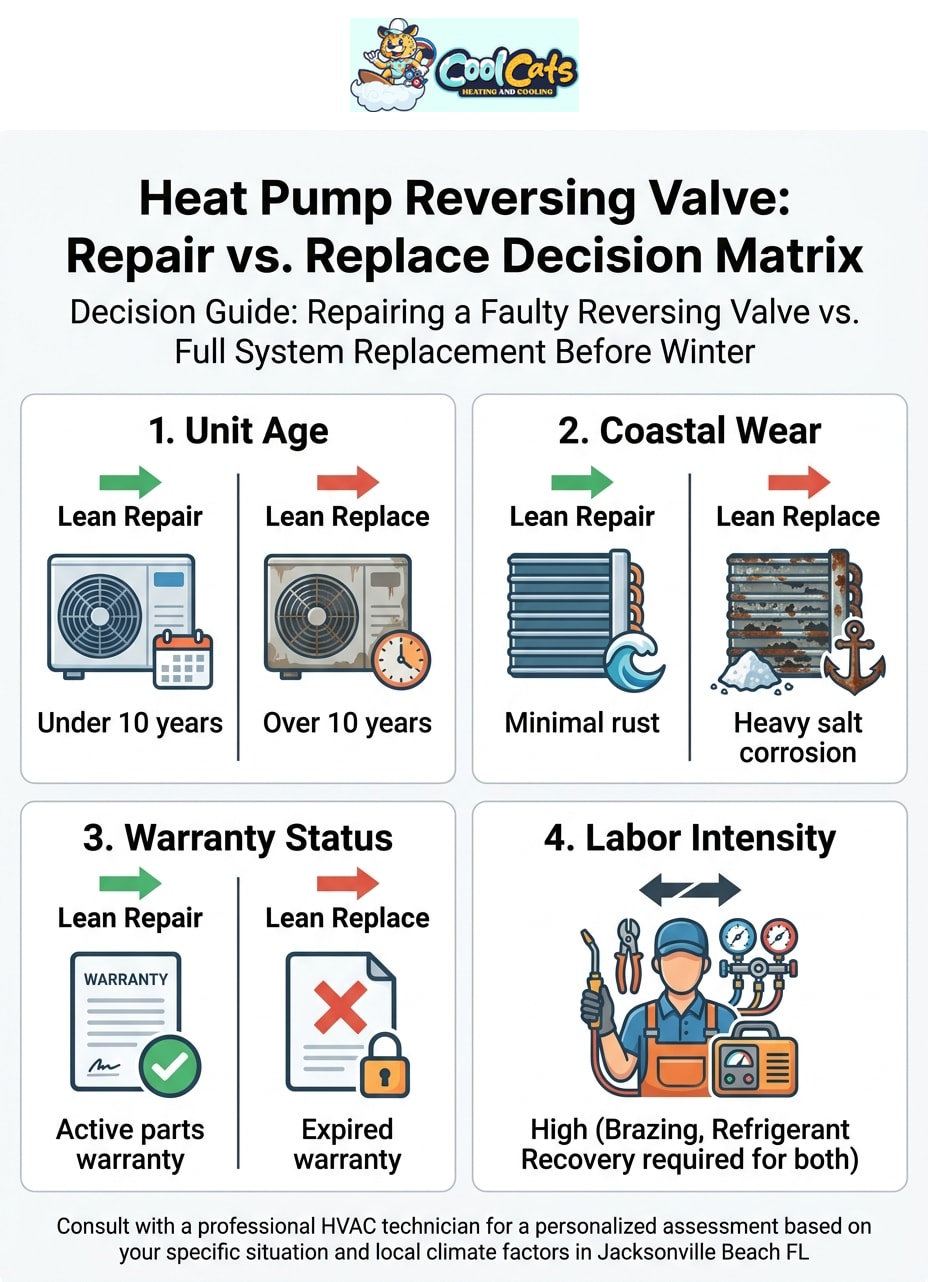
To help you weigh your options objectively, we have broken down the core considerations into a clear decision matrix. Evaluating these factors side-by-side clarifies whether a short-term fix or long-term stability is the right move for your home.
• Equipment Age — Repairing the Reversing Valve: Best if the unit is under 8-10 years old and still under a manufacturer parts warranty. — Replacing the Full System: Highly recommended if the unit is over 10 years old or uses outdated R-22 refrigerant.
• Coastal Durability — Repairing the Reversing Valve: Leaves existing rusted coils and brittle copper lines in place, risking secondary failures. — Replacing the Full System: Installs fresh, treated components designed to withstand salt air and high humidity.
• Energy Efficiency — Repairing the Reversing Valve: Maintains your current, likely lower, efficiency rating. No change to high monthly utility bills. — Replacing the Full System: Yields immediate monthly energy savings through modern variable-speed technology.
• Labor Investment — Repairing the Reversing Valve: Requires intensive labor, refrigerant recovery, and complex brazing for a single part. — Replacing the Full System: Channels labor costs into a completely new, reliable system with guaranteed performance.
• Warranty Status — Repairing the Reversing Valve: Only the newly installed valve will carry a limited part warranty; the rest of the unit is unprotected. — Replacing the Full System: Provides a comprehensive, multi-year manufacturer warranty covering all internal parts.
Overcoming the Investment Hurdle with Flexible Financing
It is completely understandable that an unexpected full system replacement can be a significant budget shock, especially when it happens right before the holidays. No homeowner plans to replace their entire HVAC system on a random Tuesday in November. Because of this upfront hurdle, many people feel pressured into choosing the repair option, even when they know the older unit is a sunk-cost trap that will likely break down again soon.
However, avoiding that sunk-cost trap on an old, rusting unit is almost always financially wiser in the long run. The key to making a smart, long-term replacement decision accessible is leveraging modern purchasing tools. You do not have to drain your savings account or sacrifice your winter comfort due to immediate budget constraints.
This is where CoolCats' flexible financing options change the equation. By utilizing structured financing, you can bridge the gap between an aging, failing system and a brand-new, high-efficiency unit. Financing turns a massive upfront burden into manageable, predictable monthly terms. In many cases, the monthly energy savings generated by a new, highly efficient heat pump can help offset a portion of that monthly financing cost.
To learn more about how you can upgrade your home without the financial stress, explore our HVAC financing options to find a plan that fits your family's budget.
Exploring Your Options
When you sit down to review financing, the process is designed to be seamless and stress-free:
• Fast approvals: You can apply for financing quickly, often receiving an answer within minutes, ensuring your installation is not delayed while you freeze.
• Customized terms: From low-interest plans to flexible term lengths, you can balance your monthly financing costs against your immediate energy savings to find the perfect middle ground.
Secure Your Winter Comfort: Take Action Before the Cold Settles In
The transition from mild fall weather to a biting November cold front transition happens quickly on the coast. If you are currently dealing with a heat pump stuck in cooling mode, time is of the essence. Waiting until the deeper winter cold settles in will only make your home more uncomfortable and put additional strain on an already struggling system.
Your first step should always be to schedule a professional diagnostic with the CoolCats team. Our licensed technicians can definitively confirm whether the reversing valve has failed mechanically, or if a simpler electrical issue is to blame. From there, you can get a comprehensive, free estimate to compare the exact repair and replacement scenarios tailored specifically to your home and your equipment's condition.
If you are still weighing the financial aspects of a sudden breakdown, reading more about navigating AC financing when systems fail can provide valuable insights. Make the choice between repairing a faulty reversing valve vs. full system replacement before winter with confidence, and secure your family's comfort for the season ahead.
Frequently Asked Questions
Why is my heat pump stuck in cooling mode?
When a heat pump is stuck in cooling mode, the most common cause is a failed reversing valve. This four-way valve is responsible for shifting the flow of refrigerant to switch the system between heating and cooling. If the valve's electrical solenoid burns out, or if the internal sliding mechanism becomes jammed with debris or mechanical wear, the system physically cannot reverse its cycle. This leaves your unit trapped in its default cooling position, blowing cold air even when your thermostat is set to heat.
Can a reversing valve be repaired or does it have to be replaced?
A reversing valve itself generally cannot be repaired; the entire component must be cut out and replaced. Because the internal sliding block is permanently sealed inside a brass casing, there is no way to open it up, clean it, or fix a mechanical jam. The only exception is if the external electrical solenoid coil has failed while the brass valve remains perfectly functional. In that specific scenario, our technicians can replace just the coil, which is a much faster and less invasive process.
Is it worth replacing a reversing valve on an older heat pump?
Replacing a reversing valve on an older heat pump is rarely recommended due to the intense labor required and the risk of secondary failures. The process involves recovering all refrigerant, cutting out the old valve, and brazing a new one near sensitive, aging copper lines. If your unit is over 10 years old, out of warranty, or heavily corroded from coastal salt air, investing in this complex repair is often a sunk cost. Upgrading to a new system provides better long-term value and reliability.
How long does a heat pump reversing valve typically last?
A reversing valve is designed to last the entire lifespan of the heat pump, which is typically 12 to 15 years under normal conditions. However, in coastal environments where salt air accelerates galvanic corrosion, or in systems that run almost year-round, the valve may fail prematurely. Lack of routine maintenance, electrical surges, or a buildup of internal sludge from degraded compressor oil can also shorten the lifespan of the valve significantly.
Does replacing a reversing valve require new refrigerant?
Replacing a reversing valve requires the complete evacuation of the system's existing refrigerant, but whether you need entirely new refrigerant depends on its condition. A technician will use a specialized machine to pump the chemical into a recovery tank. If the existing refrigerant is clean and free of acid or moisture, it can often be weighed back into the system after the repair. If the system was heavily contaminated, fresh refrigerant will be required to ensure proper operation.
How does coastal salt air affect my heat pump's lifespan?
Coastal salt air drastically reduces the lifespan of a heat pump by accelerating galvanic corrosion on the outdoor unit's metal components. The constant exposure to airborne salt eats away at the aluminum fins and makes the copper refrigerant lines highly brittle. Over time, this degradation makes the entire system prone to refrigerant leaks and mechanical failures. Because of this harsh environment, coastal heat pumps often require replacement years earlier than identical units installed further inland.
Are there tax credits available for replacing an old heat pump?
Yes, upgrading to a modern, high-efficiency heat pump often qualifies homeowners for various financial incentives. Generic federal tax credits may apply to qualifying installations that meet specific Department of Energy efficiency standards. Additionally, many local utility companies offer rebate programs to encourage the adoption of energy-saving equipment. It is always recommended to consult with your HVAC installer and a tax professional to verify which current programs apply to your specific replacement project.
Customer Testimonials


Community Involvement


Latest Blogs

Repairing a Faulty Reversing Valve vs. Full System Replacement Before Winter

Why Jacksonville's Shift to Cooler Nights Reveals Hidden Ductwork Leaks