Why Your AC Freezes When Jacksonville Humidity Drops in Early Fall

Why the September Weather Shift Causes Sudden AC Freeze-Ups
As the intense summer heat finally breaks and we enter the September early fall transition, many homeowners contact our team at CoolCats, LLC wondering why your AC freezes when Jacksonville humidity drops in early fall. It is incredibly frustrating to discover your evaporator coil encased in a solid block of ice just as the weather starts to become comfortable. You might assume the sudden drop in outdoor temperatures caused the freeze, but in our experience servicing coastal Florida homes, the real culprit is a fascinating shift in how your air conditioning system handles airborne moisture.
If you need immediate assistance with a frozen system, learn more about our Air Conditioning services or schedule your Jacksonville AC maintenance today.
Living in Jacksonville Beach, FL, means dealing with upper 90-degree temperatures paired with suffocating humidity for months on end. During this time, your air conditioner works overtime, battling both the high temperature and the thick moisture in the air. When September arrives, the intense heat breaks, and the air becomes noticeably drier. Temperatures settle into the moderate 80s, and the heavy blanket of humidity lifts.
Counterintuitively, our technicians find that this pleasant weather shift is exactly what triggers sudden freeze-ups in struggling HVAC systems. A frozen air conditioner is rarely a fluke caused by the outside air getting a little cooler. Instead, it is a matter of basic HVAC physics being exposed by the changing seasons. To understand why this happens, you have to look at the massive amount of work your system was doing during the peak of summer, and what happens when half of that workload suddenly disappears.
• Peak Summer — Typical Temperature: Upper 90s — Humidity Levels (Latent Heat): Extremely High — Impact on the AC Evaporator Coil: Absorbs massive heat load; metal stays safely above 32°F
• Early Fall (September) — Typical Temperature: Moderate 80s — Humidity Levels (Latent Heat): Dropping Significantly — Impact on the AC Evaporator Coil: Reduced heat load; vulnerable systems drop below 32°F
When you find a block of ice inside your indoor unit or on the copper pipes outside, your system is crying out for a diagnostic check. The weather change merely revealed a pre-existing vulnerability that the heavy summer heat was hiding.
How Dropping Humidity Changes Your AC's Cooling Load
To understand why a system freezes when the weather improves, our team looks at exactly what your air conditioner is removing from your home. An AC unit does not just pump cold air into the house; it actively extracts heat from the indoor air. This extraction process deals with two very different types of heat: sensible heat and latent heat.
Sensible vs. Latent Heat Explained
Sensible heat is the heat you can actually feel and measure with a standard thermometer. When you look at your thermostat and see that the room is 82°F, you are looking at a measurement of sensible heat. Lowering the sensible heat is what makes the air feel cooler against your skin.
Latent heat, on the other hand, is the heat energy trapped inside airborne moisture. In Florida, latent heat is a massive factor. When water vapor is suspended in the humid air, it holds a tremendous amount of energy. Your air conditioner removes this latent heat by drawing the warm, moist air over the freezing-cold evaporator coil. The moisture condenses into liquid water (which drips outside), releasing its trapped heat energy directly into the coil.
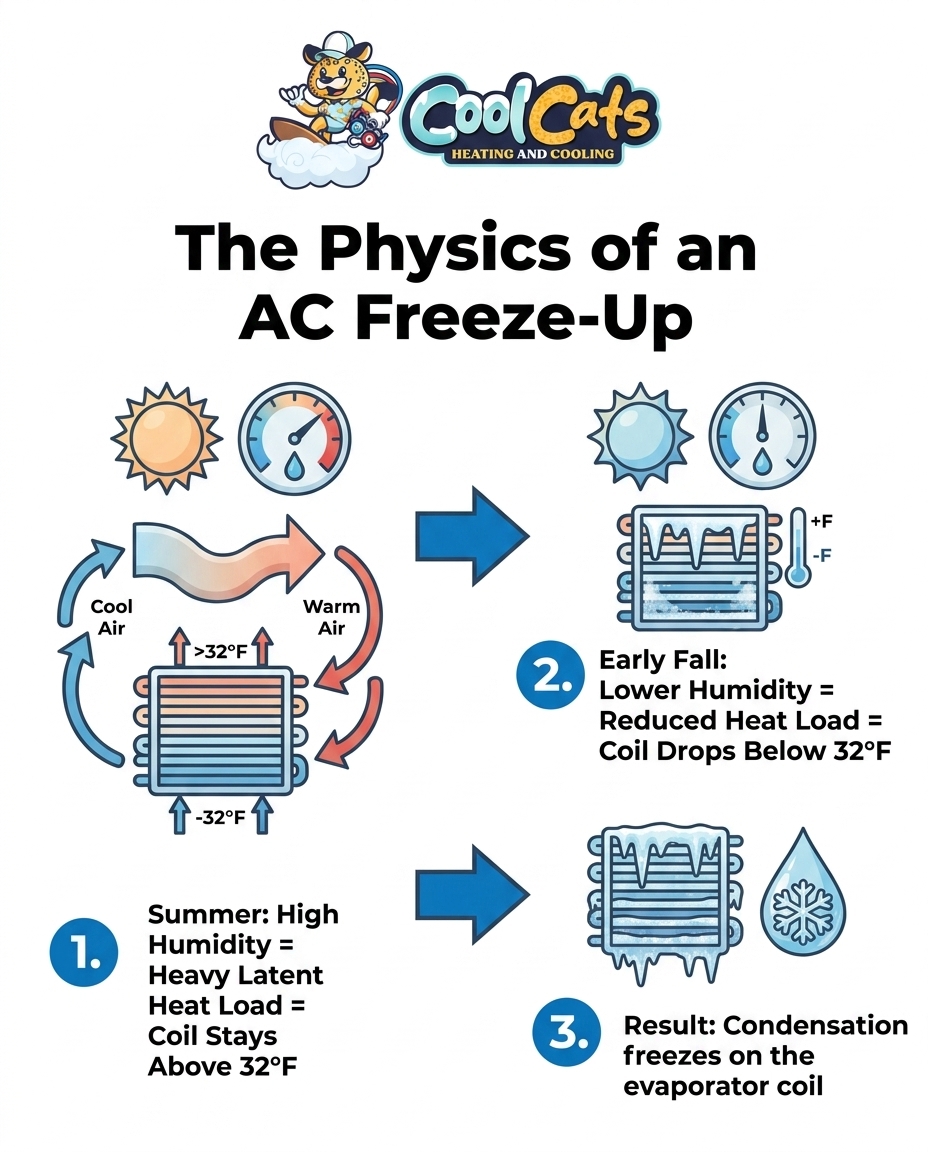
During a typical summer in Jacksonville Beach, the extreme subtropical humidity creates a massive "heat load" on your system. The constant condensation of thick moisture transfers so much heat into the evaporator coil that the metal stays warm enough to avoid freezing. The heavy moisture acts as a thermal buffer.
As the local experts who understand the unique mechanical stress that Jacksonville's specific coastal climate puts on HVAC equipment, our team at CoolCats, LLC sees this pattern every single year. Homeowners routinely search for answers when their AC freezes when humidity drops, not realizing that the heavy summer moisture was the only thing keeping their struggling system from icing over months ago.
Why a Struggling AC Survives Summer but Freezes in Fall
If your air conditioner was running perfectly all summer, why does it suddenly turn into an icebox in September? The answer lies in the delicate balance of temperature and airflow over your indoor evaporator coil. The refrigerant running through that coil is naturally extremely cold—often well below the freezing point of water. It relies on a constant supply of warm, humid air blowing across it to keep the physical metal of the coil above 32°F.
When the latent heat (humidity) suddenly drops in the early fall transition, that massive thermal buffer disappears. The air blowing over the coil is cooler and much drier. Without the heavy moisture load transferring heat into the metal, the evaporator coil's operating temperature naturally plummets.
This is where our technicians commonly expose hidden problems:
• Restricted Airflow: If your air filter is dirty, or your blower motor is weak, not enough air is moving over the coil. In the summer, the extreme humidity made up for the lack of airflow. In the fall, the lack of airflow causes the coil to drop below freezing.
• Low Refrigerant: If your system has a slight refrigerant leak, the pressure inside the coil drops. Lower pressure means the refrigerant gets even colder than it should be. The summer heat masked this issue, but the cooler fall air lets the coil dip past the freezing point.
Once the metal drops below 32°F, the small amount of condensation left in the air freezes directly onto the coil. Ice is an insulator. Once a thin layer of ice forms, it blocks the warm air from reaching the coil, causing the temperature to drop even faster. This creates a runaway effect, quickly turning the entire coil into a solid block of ice. We constantly remind our customers: the weather shift didn't break your AC; it merely exposed a pre-existing vulnerability that requires attention.
Tracing the Ice: From the Evaporator Coil to the Suction Line
Most homeowners do not regularly look inside their indoor air handler, which means the freezing process usually goes unnoticed until secondary symptoms appear. The ice always begins at the indoor evaporator coil, where the heat exchange takes place. However, as the coil becomes completely encased in ice, the freezing effect begins to travel.
Because the ice blocks the warm air from reaching the refrigerant, the refrigerant remains freezing cold as it leaves the house and travels back to the outdoor compressor. This causes the moisture in the outdoor air to freeze onto the copper piping. When our technicians arrive for a service call and walk outside to the condenser unit, we often notice a thick layer of white frost or solid ice wrapping around the larger, insulated copper pipe. This is a clear indicator to our team that we need to investigate what causes the suction line to freeze up.
What to Look For Around Your Equipment
• Warm air from vents: The ice blocks the airflow inside, meaning the blower is just pushing unconditioned air through the house.
• Water pooling indoors: As the ice slowly melts during off-cycles, it can overwhelm the drain pan and leak onto your floor.
• White frost outside: The larger copper line connected to your outdoor unit will look like it belongs in a freezer.
• Hissing or bubbling sounds: Unusual noises from the refrigerant lines can indicate pressure issues caused by the blockage.
If you notice any of these signs during the September early fall transition, it is critical that you take action immediately. Allowing the system to continue running while frozen puts immense strain on the outdoor compressor. The compressor is designed to pump refrigerant gas, not liquid. If the refrigerant doesn't absorb enough heat indoors because of the ice, it can return to the compressor as a liquid—a catastrophic event known as "liquid slugging" that can destroy the compressor entirely.
What to Do First: Safe Thawing and Filter Checks
Finding your air conditioner covered in ice is alarming, but the immediate response is straightforward. The most important thing you can do is protect the expensive components of your system from permanent damage while the ice melts. Here are the safe, actionable steps we recommend you take immediately.
1. Turn the thermostat from "Cool" to "Off" immediately. This stops the outdoor compressor from running and prevents catastrophic damage. Do not let the system continue trying to cool the house.
2. Turn the fan setting from "Auto" to "On." This forces the indoor blower motor to run continuously. It will pull warm indoor air across the frozen coil, which dramatically accelerates the thawing process.
3. Check your air filter. A severely clogged air filter is the single most common cause of restricted airflow. If the filter is caked in dust and pet hair, replace it immediately with a fresh one.
4. Prepare for excess water. As the block of ice melts, it will create a massive amount of water. Keep old towels handy around the indoor unit, as the drain pan may overflow if the ice melts too quickly.
How Long Does Thawing Take?
Patience is required during this process. A solid block of ice inside an air handler can take anywhere from a few hours to a full 24 hours to melt completely. You must wait until the ice is 100% gone before attempting to run the cooling cycle again.
Strict Warning: Never attempt to chip the ice away with a knife, screwdriver, or any other tool. The aluminum fins on the evaporator coil are incredibly fragile, and the copper tubing holding the pressurized refrigerant is easily punctured. A single slip of a tool can destroy the coil and release all the refrigerant, turning a simple thaw job into a major, costly replacement. Furthermore, never attempt to check or add refrigerant yourself; this requires specialized gauges and a licensed professional.
Many homeowners find that their AC freezes when humidity drops simply because they forgot to change a dirty filter. If you thaw the unit, replace the filter, and the system runs perfectly afterward, you have likely solved the problem.
When an Iced-Over AC Requires Professional Diagnostics
If you have completely thawed the system, replaced the air filter with a clean one, and turned the cooling back on—only for the unit to freeze up again a few hours later—you have reached the boundary of safe DIY troubleshooting. A recurring freeze-up indicates a mechanical or chemical failure that requires professional intervention.
At this stage, our technicians find the most common culprits are low refrigerant levels or a failing blower motor. Refrigerant does not "used up" like gas in a car; if it is low, it means there is a leak somewhere in the closed loop that must be located and sealed by a certified technician. Alternatively, the indoor blower motor might be wearing out, spinning too slowly to move the necessary volume of air across the coil.
Getting to the root cause requires honest, accurate diagnostics. For instance, our crew recently helped a local homeowner who dealt with an old, misplaced air and heat compressor that ran erratically and struggled to keep up with the changing seasons in Jacksonville Beach FL. Rather than just patching a failing system, our professional technicians assessed the unit, explained all available options without pressure, and performed a full installation that reconfigured the space for significantly better performance.
This is why our team at CoolCats, LLC emphasizes a commitment to finding the exact problem and performing precise repairs without overcharging. We believe in transparency and solving the root cause of the issue, whether that means sealing a minor leak or discussing a system upgrade. If it's time for a replacement, we often remind customers that federal tax credits and utility incentive programs may apply to qualifying heat pump installations (be sure to verify current programs with your utility or tax professional). Scheduling pre-heating-season AC maintenance and replacement evaluations can catch these vulnerabilities before they leave you sweating in your own home.
Frequently Asked Questions About Fall AC Freeze-Ups in Jacksonville
Why is my AC freezing up in the fall?
Your AC freezes in the fall because the sudden drop in outdoor humidity removes the heavy "heat load" that was previously warming your evaporator coil. During the summer, the intense moisture kept the coil above freezing. Once that moisture vanishes in the September early fall transition, pre-existing issues like low airflow or slight refrigerant leaks cause the coil's temperature to plummet below 32°F, resulting in a solid block of ice.
Does low humidity make AC freeze?
Low humidity itself does not break an air conditioner, but it does remove the latent heat buffer that prevents a struggling system from freezing. When the air is dry, there is less heat energy transferring into the cold evaporator coil. If your system is already suffering from a dirty filter or low refrigerant, the drop in humidity is often the final trigger that pushes the coil temperature below the freezing point.
How do I safely thaw my AC unit?
The safest way to thaw your AC unit is to turn the thermostat setting to "Off" and switch the fan setting to "On." This stops the cooling process while forcing warm indoor air over the frozen coil to melt the ice naturally. You should place towels around the indoor unit to catch any overflowing water. Never use sharp tools to chip away the ice, as this can easily puncture the delicate refrigerant lines.
Why is my AC blowing warm air suddenly in September?
If your AC is suddenly blowing warm air, the indoor evaporator coil has likely frozen over. The solid block of ice physically blocks the cold refrigerant from absorbing heat out of your home's air. As a result, the blower motor simply pushes unconditioned, warm air through your ductwork and out of your vents. Thawing the system and checking the filter is the first step to resolving this.
Can a dirty filter cause my AC to freeze when the weather cools down?
Yes, a dirty air filter is the most common cause of an AC freeze-up we see in the field. A clogged filter severely restricts the amount of warm air flowing over the cold evaporator coil. During the intense heat of summer, the system might barely survive because of the high humidity, but once the weather cools down and the air dries out, that lack of airflow immediately causes the coil to drop below freezing and turn to ice.
Restore Your Home's Comfort This Fall
The transition out of summer should be a time to enjoy the milder weather, not a time to battle a malfunctioning air conditioner. Fall weather shifts in Jacksonville Beach FL shouldn't result in an iced-over AC, and discovering a frozen coil doesn't necessarily mean your system is ruined. In many cases, the changing humidity simply exposed a minor airflow restriction or a small refrigerant issue that can be swiftly corrected.
With proper professional diagnostics from the team at CoolCats, LLC, the root cause of the freeze-up can be identified and resolved quickly, ensuring your equipment operates safely and efficiently. This early fall period is also the perfect time for a pre-heating-season tune-up and to evaluate your indoor air quality (IAQ) before you seal up the house for winter. Don't let a struggling system leave you uncomfortable or risk permanent damage to your compressor. Schedule a comprehensive inspection today to ensure your system is perfectly tuned and ready to handle whatever the changing seasons bring.
Customer Testimonials


Community Involvement


Latest Blogs

Does a Labor Warranty Cover Coastal Corrosion on a New Jacksonville Beach AC Installation?
How We Help Jacksonville Families Navigate AC Financing When Their System Fails Unexpectedly