Does a Labor Warranty Cover Coastal Corrosion on a New Jacksonville Beach AC Installation?

Understanding HVAC Warranty Limits in Coastal Environments
Are you wondering, does a labor warranty cover coastal corrosion on a new Jacksonville Beach AC installation? Here at Cool Cats Heating and Cooling, it is a common question we hear from property owners living near the water. You invest in a brand-new cooling system and assume the equipment warranty protects you from every possible failure. However, in our years serving the Jacksonville Beach area, we've seen firsthand how the coastal environment plays by its own rules. Airborne salt is incredibly harsh on metal components, and understanding who pays for the labor when environmental damage strikes is an important part of homeownership.
If you need expert air conditioning services or are planning a new AC installation in Jacksonville, knowing these details upfront saves you from unexpected out-of-pocket costs down the road. Clarifying the precise limits of contractor labor warranties versus manufacturer parts warranties empowers you to protect your investment.
Jacksonville Beach coastal and Intracoastal properties face unique environmental exposure. The continuous high humidity and airborne salinity create a highly corrosive atmosphere that standard inland systems rarely encounter. This guide explains how salt air affects your equipment, what to ask about warranty coverage, and how you can defend your cooling system against the harsh coastal elements.
Do Labor Warranties Cover Salt Air Damage?
It depends on the warranty. Labor warranties are generally written around the installation work, and manufacturer and labor warranty terms vary. How salt air corrosion is treated depends on the specific terms for your system, so ask us what your warranty covers.
To understand why, you have to look at how salt affects metal. When airborne salt settles on the different metals inside your AC unit, it triggers a process called galvanic corrosion. This chemical reaction eats away at the metal structure of the unit. You might notice white powdery buildup, flaking fins, or rust spots. Eventually, this corrosion eats through the copper tubing and causes refrigerant leaks.
Because galvanic corrosion is a chemical reaction to the environment, it is often treated differently from a defect in the equipment or the installation. That is why it pays to know your specific warranty terms.
This creates a common point of confusion. A parts warranty and a labor warranty are separate, and each has its own terms. We always recommend reading the fine print regarding environmental exclusions on your specific equipment.
Contractor Labor Warranties vs. Manufacturer Parts Warranties
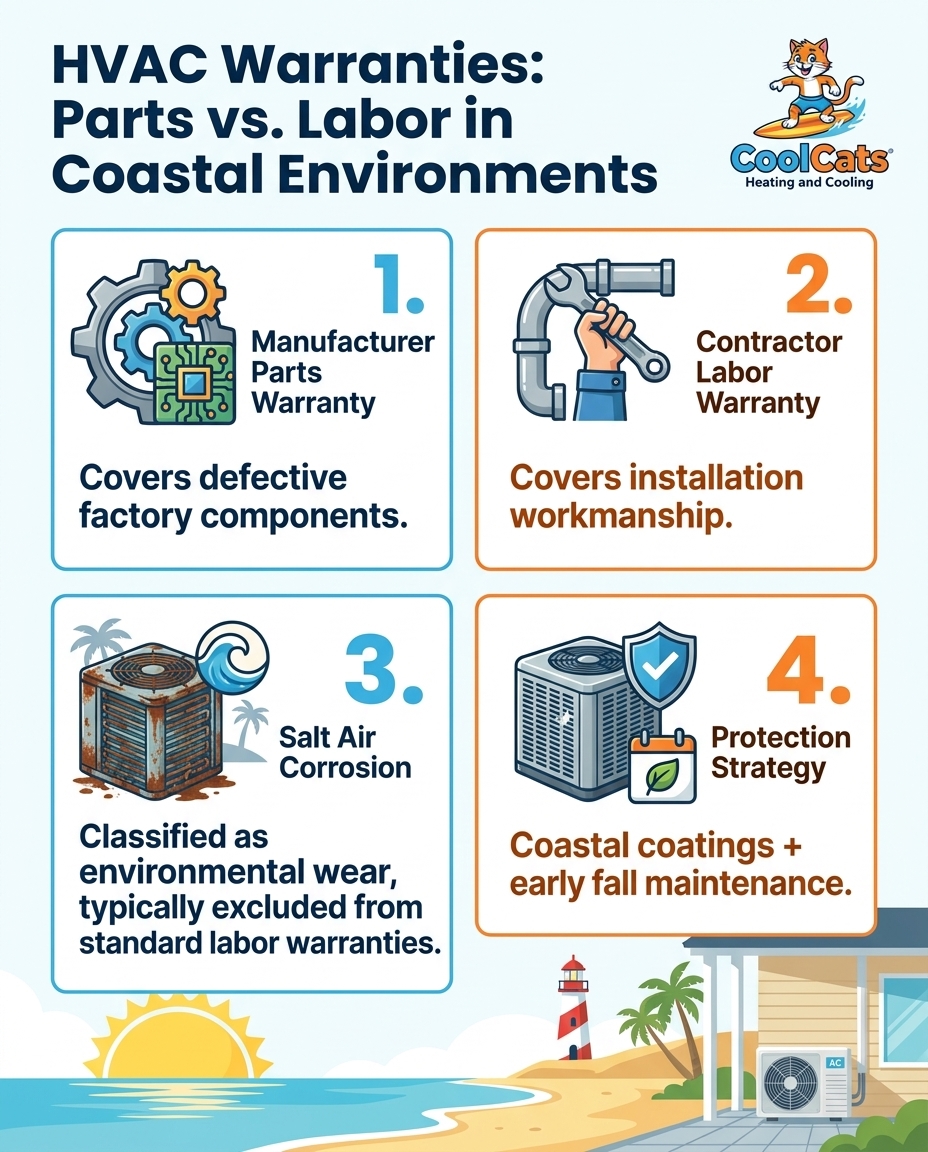
To fully grasp your coverage, you need to understand the difference between the two primary types of warranties that come with a new AC installation. They cover entirely different aspects of your cooling system.
• Manufacturer Parts Warranty — What It Covers: Defective factory parts (compressors, coils, fan motors) that fail due to manufacturing errors. — Questions to Ask: Is labor included? How are corrosion and maintenance handled? Is there a coastal model?
• Contractor Labor Warranty — What It Covers: The installation work itself. Terms vary by contractor. — Questions to Ask: How long does it last, what does it cover, and how is salt air corrosion handled?
The biggest disconnect for homeowners happens when a part fails due to salt air. A homeowner with a long parts warranty may still face out-of-pocket labor costs, depending on the labor warranty terms. This is why our team at Cool Cats Heating and Cooling explains our two-year labor warranty on installations upfront, so homeowners know what is and isn't covered from day one.
For example, a homeowner replacing several older systems that have succumbed to years of salt exposure should have the coverage explained before work begins: our installations come with a two-year labor warranty, and manufacturer coverage depends on the equipment. Knowing what the coverage includes, and how to keep it active, avoids surprises later.
Understanding when to schedule your new HVAC installation is only half the battle; knowing the exact terms of your coverage keeps that system running affordably for years.
What Can Affect Warranty Coverage?
Even if your system suffers a standard mechanical failure, certain actions can affect labor and parts warranty coverage. Check your warranty documents, and avoid these common missteps:
• Lack of documented professional maintenance: Many manufacturer warranties have maintenance requirements, so keep your service records.
• Environmental damage: Flooding, storm debris, and salt corrosion may be treated differently from a workmanship or parts defect.
• Unauthorized DIY repairs: Attempting to fix or modify the internal components yourself can affect your coverage.
How Airborne Salinity Impacts Condenser Coils
To protect your system, you have to understand the science of salt air damage. Airborne salinity does not just sit on the surface of your AC unit; it actively attacks the metal. When continuous high humidity combines with airborne salt, it creates a highly corrosive environment.
Standard air conditioners use aluminum fins and copper tubing to transfer heat. When salt water acts as an electrolyte between these two dissimilar metals, galvanic corrosion accelerates rapidly. The aluminum fins begin to pit, turn into a white powder, and flake away. Once the fins degrade, the system cannot release heat properly, forcing the compressor to work harder and consume more electricity.
Eventually, the corrosion reaches the copper tubing. This leads to microscopic holes and massive refrigerant leaks. In our experience working along the Intracoastal Waterway, this process is significantly accelerated for properties located directly on the coast, where the salt concentration in the air is highest.
Because this degradation is a chemical reaction to the local atmosphere, it is often treated as environmental damage rather than a manufacturing or installation defect, so check how your warranty handles it.
Proactive Protection: Coastal Coatings and Upgrades
You cannot change the weather, but you can change how your equipment handles it. When you replace a system near the coast, it's worth asking how the equipment you're considering handles salt air.
Here are common ways to defend cooling systems against the coastal environment:
1. Factory-Applied Coastal Coatings: Many top-tier manufacturers offer specialized coastal models. These units feature thick, epoxy-based coatings applied at the factory to shield the coils and internal components from salt air.
2. Aftermarket Protective Coatings: Aftermarket anti-corrosion coatings are also sold for outdoor coils. Check with the equipment manufacturer about how a coating affects warranty coverage before one is applied.
3. Strategic Placement: Installing the condenser unit on the side of the house opposite the prevailing ocean breeze can significantly reduce direct salt exposure.
Some manufacturers offer different terms for coastal-coated models, so ask about them when comparing equipment. A coated system is an upfront investment that can help slow corrosion. Exploring AC financing options can make upgrading to a specialized, corrosion-resistant unit much more manageable.
Choosing a contractor experienced in selecting the right coastal equipment makes all the difference. Cool Cats Heating and Cooling can talk through equipment options for coastal homes; the right choice depends on your budget, efficiency goals, the application and equipment availability.
The Importance of Post-Summer Preventive Maintenance
Routine maintenance is your primary defense against salt corrosion and is often a condition of manufacturer warranties. While spring tune-ups are popular, as we move into September, we emphasize that the early fall maintenance window to clear summer salt accumulation is arguably the most important service visit for coastal homeowners.
During the long, humid summer months, your AC unit pulls massive amounts of air—and airborne salt—through its fins. As summer fades and the system transitions into lower-usage periods, that salt sits on the metal and eats away at it. The transition period into early fall is the absolute best time to wash away that corrosive buildup before the heating season begins.
Coil cleaning should use non-corrosive cleaners that lift the salt out of the delicate fins safely. The quick fix you should avoid: Do not attempt to pressure wash the unit yourself. High-pressure water easily bends the thin aluminum fins, blocking airflow and possibly affecting your warranty.
Many warranties call for documented professional maintenance, so check your terms. For example, a pre-heating-season tune-up the year after an installation is a good time for a technician to inspect the system, clean it safely and check airflow on every unit on the property. Routine AC maintenance and replacement evaluations catch minor corrosion before it causes a major breakdown.
Frequently Asked Questions About Coastal AC Warranties
Does an AC warranty cover corrosion?
It depends on the specific manufacturer and labor warranty terms. Salt air damage is often treated differently from a manufacturing defect, and some coastal models carry their own corrosion terms. Ask us what your specific warranty covers.
Are labor costs covered under an AC warranty?
It depends on the warranty. Manufacturer warranties generally cover defective parts, and whether labor is included varies. A contractor's labor warranty covers the installation work under its own terms. Cool Cats installations come with a two-year labor warranty; ask us what it covers for your system.
How long do AC units last in Florida near the ocean?
Salt air near the ocean can shorten the life of outdoor equipment through corrosion, and regular maintenance helps. The difference entirely depends on the protective coatings and the frequency of professional cleanings.
How do I protect my AC unit from salt air?
The best protection starts with using factory-applied or aftermarket coastal coatings on the internal coils. Beyond that, we highly recommend scheduling professional cleanings at least once a year—preferably in early fall—to remove accumulated salt. Maintaining clear airflow around the unit by trimming back vegetation also helps the system dry out faster, reducing corrosion.
What voids an HVAC warranty in coastal areas?
It depends on the warranty, so read your terms. Many manufacturer warranties have maintenance requirements, improper DIY cleaning (such as a pressure washer that damages the fins) can cause damage a warranty may not cover, and some manufacturers have rules about non-coastal equipment installed close to the shoreline.
Does adding a coastal coating after installation void the manufacturer warranty?
It depends on the manufacturer. Check the equipment warranty terms, or ask us, before an aftermarket coating is applied. A poorly applied coating can restrict airflow and make the system work harder.
Protect Your Coastal Investment with Local Expertise
Whatever your warranty covers, proactive choices can help protect your cooling system. A definitive, jargon-free understanding of your warranty limits allows you to plan ahead rather than reacting to a sudden breakdown. By choosing the right equipment and committing to professional maintenance, you can beat the harsh coastal elements.
Take control of your home's comfort before the salt air takes a toll on your equipment. Request a professional evaluation with our team to talk through equipment options for your coastal home, or request your early fall maintenance visit today. If you are ready for a durable solution, reach out to discuss your AC installation in Jacksonville with a team that truly understands the coastal climate.
Customer Testimonials


Community Involvement


Latest Blogs

Why Jacksonville's Shift to Cooler Nights Reveals Hidden Ductwork Leaks
Mitigating Condensation Buildup on AC Vents During the October Climate Transition