How Minor Refrigerant Leaks Hinder Your Heat Pump's Ability to Warm Your Home

The Shock of the Season: When Fall Heating Fails
The first October chill has finally arrived, and you are about to discover exactly how minor refrigerant leaks hinder your heat pump's ability to warm your home. Here at Cool Cats Heating and Cooling, we see this exact scenario play out every fall. In the Jacksonville Beach area, the transition from long, sweltering summers to milder, yet distinctly chilly autumns creates a unique stress test for your heating and cooling equipment. You walk over to the thermostat, switch the system from "cool" to "heat" for the first time in months, and wait for that familiar wave of comfort. You hear the outdoor unit kick on and the blower motor ramp up, but as the minutes tick by, the house still feels cold.
When you hold your hand up to the register, you are met with lukewarm supply air at the vents instead of the robust, warm airflow you expect. This specific moment of frustration is incredibly common in our service area, and it is rarely a case of the system simply needing time to "adjust" to the new season. When a system runs continuously but fails to elevate the indoor temperature, you are dealing with a mechanical failure. More often than not, the hidden culprit behind this sudden lack of performance is a minor loss of refrigerant that went entirely unnoticed during the warmer months.
If you rely on heat pump systems to keep your home comfortable year-round, understanding the mechanics of this seasonal failure is the first step toward a permanent solution.
The Delayed Realization: Summer Cooling vs. Fall Heating
The problem: Many homeowners are caught off guard by a fall heating failure because the system seemed to be working perfectly fine just a few weeks prior. It is difficult to understand how a catastrophic mechanical issue could develop overnight while the system was barely running. Our technicians consistently find that the leak did not happen overnight. It is typically a lingering summer issue that was simply exposed by the aggressive demands of the seasonal shift.
The cause: During the late summer and early fall, the cooling load on your home drops significantly. The days get shorter, the sun angle lowers, and outdoor temperatures become far more forgiving. Because the system does not have to work nearly as hard to maintain a comfortable indoor temperature, a slight undercharge of refrigerant can easily go unnoticed. The heat pump might run a few minutes longer per cycle to cool the house, but it still gets the job done. However, the moment you reverse the cycle to extract heat from the cool October air, the physics of the process change. Heating requires a higher volume of refrigerant to capture ambient thermal energy efficiently. That same minor leak that allowed the system to limp along in September suddenly cripples its ability to function in October.
The solution: Recognizing that a seasonal failure is often rooted in a pre-existing condition validates the need for professional diagnostics. Instead of hoping the system will eventually catch up, reaching out for professional heat pump repair services ensures the root cause is identified before the weather gets even colder.
The Physics of Heat Extraction: How Your System Works
To understand why a minor leak causes such a massive drop in performance, we often explain the basic thermodynamics of heat transfer to our customers. Heat pumps do not generate heat by burning fuel or using electrical resistance strips like a space heater. Instead, they operate on a simple principle: they move existing heat energy from one place to another.
The Role of the Refrigerant Cycle
Refrigerant is the lifeblood of this heat transfer process. It is a specialized chemical compound designed to absorb and release heat rapidly as it changes states between a liquid and a gas. When your system is in heating mode, the reversing valve shifts, directing cold, low-pressure liquid refrigerant to the outdoor coil. Because this liquid is significantly colder than the outdoor air—even on a chilly day—it absorbs the ambient heat energy from the atmosphere. As it absorbs this heat, it boils into a gas.
The compressor then takes this warm gas and squeezes it, drastically increasing its pressure and temperature. This superheated gas is pumped into the indoor coil, where the blower fan pushes air across it. The heat transfers from the hot coil into your home's air, warming the rooms. As the heat leaves the refrigerant, it condenses back into a liquid, flows back outside, and the cycle repeats.
Why Exact Volume is Non-Negotiable
This entire process is mathematically balanced. The system's capacity to absorb, transport, and release heat is directly tied to the exact volume of refrigerant circulating through the copper lines. The manufacturer engineers the compressor, the coils, and the expansion valve to operate with a highly specific mass of refrigerant. When that volume drops even slightly, the system loses its ability to absorb enough thermal energy to produce anything more than lukewarm supply air at the vents.
Why Lower Refrigerant Volume Cripples the Heating Cycle
When the first October chill sets in, the outdoor air holds less ambient heat than it did during the summer. Extracting that heat becomes a more demanding task for your equipment. Here is exactly how a reduced volume of refrigerant cripples the heating cycle step-by-step:
1. Reduced Absorption Capacity: With less refrigerant flowing through the outdoor coil, there is physically less chemical surface area available to absorb the limited ambient heat from the cold outdoor air.
2. Lower Operating Pressures: The loss of volume causes the pressure inside the system to drop. The compressor struggles to build enough pressure to adequately superheat the gas before it enters your home.
3. Weak Heat Transfer: Because the gas entering the indoor coil is not hot enough, the air blowing across the coil barely warms up. This is what causes the lukewarm supply air at the vents.
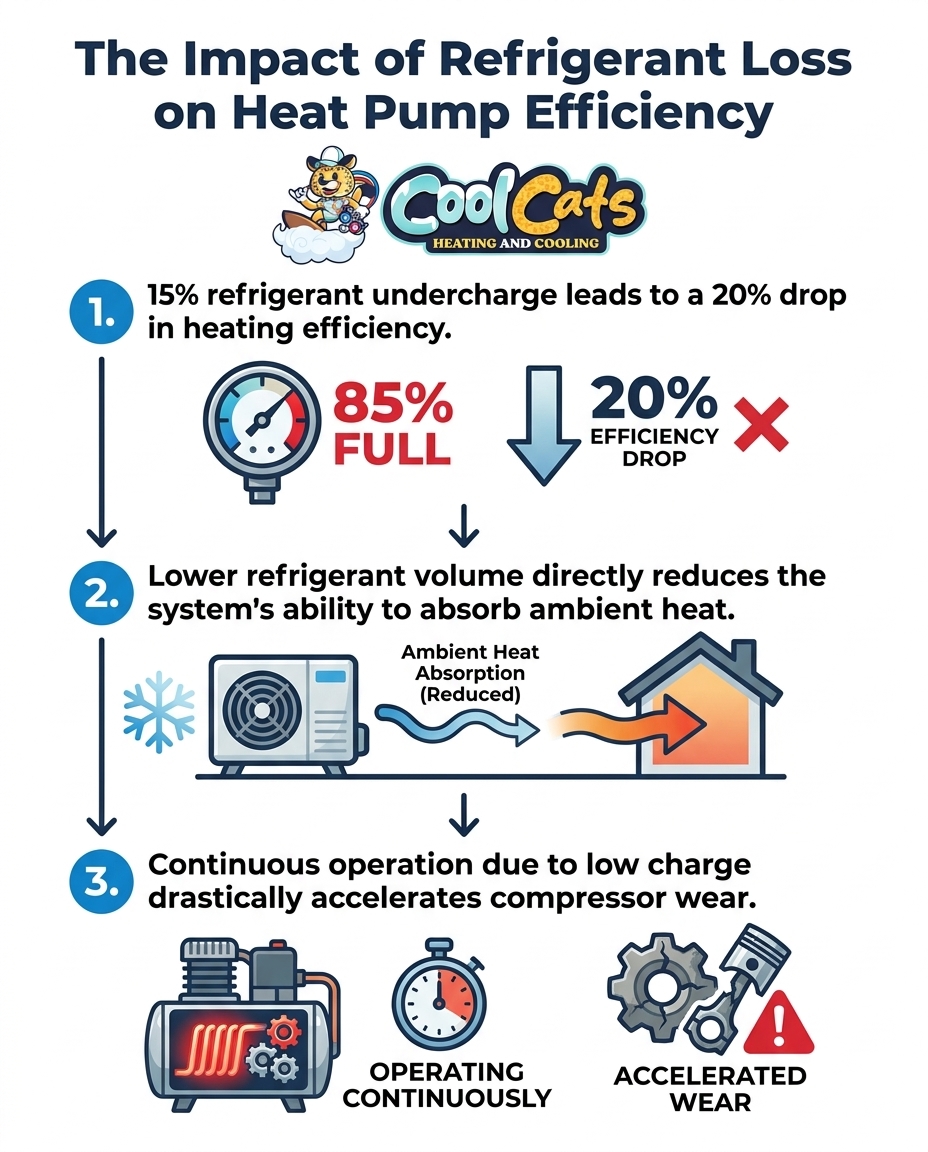
4. Continuous Operation: The thermostat registers that the indoor temperature is not rising, so it commands the system to keep running. The unit runs endlessly, consuming massive amounts of electricity, without ever reaching the set point.
The impact of this chain reaction is severe. Even a modest undercharge cuts how much heat the system can move. That explains why a system that seems fine on a mild day will fail spectacularly when the temperature drops.
• Full Factory Charge — Cooling Performance (Mild Late Summer): Short, efficient cycles; excellent humidity removal. — Heating Performance (First Fall Chill): Rapid heat transfer; strong, warm airflow at vents.
• 10-15% Undercharge — Cooling Performance (Mild Late Summer): Slightly longer cycles; feels adequate to the homeowner. — Heating Performance (First Fall Chill): Continuous running; lukewarm supply air; failure to reach set point.
• Severe Leak — Cooling Performance (Mild Late Summer): Ice buildup on indoor coil; warm air blowing inside. — Heating Performance (First Fall Chill): System locks out on low pressure; potential compressor damage.
Recognizing the Symptoms: Is It Just 'Warming Up'?
The problem: One of the most common misconceptions among homeowners is the belief that a heat pump blowing cool air initially is just "warming up" for the season. Because heat pumps deliver air at a lower temperature than traditional gas furnaces, the air can sometimes feel cool to the touch if you stand directly over a vent. However, if the house itself is not getting warmer, you are not experiencing a warm-up phase—you are experiencing a mechanical failure.
The cause: When a leak is present, the primary symptom is continuous operation paired with lukewarm supply air at the vents. Because the system cannot extract enough heat, it runs endlessly trying to satisfy the thermostat. You may also notice secondary signs of a low charge. Ice formation on the outdoor coils during heating mode is a strong indicator of pressure issues, as is a faint hissing or bubbling sound near the refrigerant lines.
The solution: Do not wait for the system to fix itself. Validating the need for professional diagnostics is critical. Real-world interventions prove the value of acting quickly. For example, a heat pump that stops working completely during a temperature dip needs a technician to diagnose the underlying mechanical issue before it can run reliably again. If you find yourself troubleshooting a heat pump that won't turn on or won't blow warm air, seeking expert help immediately is the safest path forward.
The Hidden Costs of Ignoring a Minor Leak
We always tell our customers that ignoring a minor leak or settling for a quick "top off" is a costly gamble with their HVAC equipment. Refrigerant operates in a closed-loop system. It does not evaporate, burn off, or get used up over time. If your system is low on refrigerant, there is a physical hole in the copper tubing, the coil, or a fitting that must be addressed.
Compressor Strain and Premature Failure
The compressor is the heart of your heat pump, and it relies on a steady flow of returning cool refrigerant gas to keep its internal motor from overheating. When the refrigerant volume drops, the compressor is starved of this vital cooling effect. It begins to run hotter and work harder to pump the remaining fluid. Over time, this extreme thermal stress degrades the internal windings and breaks down the lubricating oil, eventually leading to catastrophic compressor failure.
The Financial Impact of Continuous Operation
Beyond the risk to the equipment, ignoring a leak can cause a significant spike in your monthly energy consumption. A heat pump that runs continuously to deliver lukewarm supply air at the vents is pulling maximum amperage hour after hour. Fixing a minor leak early not only restores your comfort but protects your investment and ensures your home heating solutions operate at peak efficiency before mid-winter weather sets in.
Proactive Diagnostics: Catching Micro-Leaks Before the Cold Snap
Coastal climates demand year-round HVAC reliability. In the Jacksonville area, the cooling-to-heating transition is the most vital time for an equipment inspection. Because heat pumps work 365 days a year, the wear and tear is constant. Catching micro-leaks before the first October chill hits requires professional tools and a proactive approach.
Licensed technicians use highly sensitive electronic leak detectors, ultrasonic acoustic tools, and specialized ultraviolet dyes to pinpoint micro-leaks that are completely invisible to the naked eye. Once the exact source of the leak is located, the standard professional procedure involves recovering any remaining refrigerant, repairing or brazing the leaking line, and performing a high-pressure nitrogen test to ensure the system is completely sealed. Finally, a deep vacuum is pulled to remove moisture, and the exact factory-specified weight of refrigerant is weighed back into the system.
This level of precision is why refrigerant handling requires licensed expertise and should never be attempted as a DIY project. At Cool Cats Heating and Cooling, our team's proactive maintenance approach is designed to identify and resolve these minor leaks before they turn into major heating failures. In our years of servicing coastal Florida homes, we've learned that thorough service makes a real difference. One example from our own work: a customer had been told by another company that his system needed to be replaced and couldn't be repaired. He called Cool Cats for another diagnosis, we found a faulty TXV (thermostatic expansion valve) causing the problem, and after we ordered and replaced the part, his existing system was back up and running. For Jacksonville homeowners, proactive diagnostics are the key to uninterrupted seasonal comfort.
Frequently Asked Questions About Heat Pump Refrigerant
Why is my heat pump blowing lukewarm air?
A heat pump blowing lukewarm air is usually struggling with a mechanical issue, most commonly a low refrigerant charge. Without enough refrigerant, the system cannot absorb sufficient heat from the outside air to warm your home. Other potential causes include a malfunctioning reversing valve, a clogged air filter restricting airflow, or a failing compressor. Professional diagnostics are required to pinpoint the exact failure.
Does low refrigerant affect a heat pump's heating mode?
Yes, low refrigerant drastically affects a heat pump's heating mode. Refrigerant is the medium that absorbs and transfers heat; a reduced volume means less heat can be captured from the outdoor air. This forces the system to run continuously, drastically lowering efficiency and resulting in cool or lukewarm air coming from the vents.
How do I know if my heat pump is leaking refrigerant?
The most obvious sign of a refrigerant leak is a system that runs constantly but fails to reach the temperature set on the thermostat. You may also notice ice building up on the outdoor coils, a sudden spike in your energy bills, or a faint hissing sound near the refrigerant lines. Because leaks can be microscopic, a professional electronic leak search is the only definitive way to confirm and locate the issue.
Can a heat pump work with low freon in the winter?
A heat pump cannot work effectively or safely with low refrigerant during the winter. As outdoor temperatures drop, the system already has to work harder to extract heat. A low charge cripples this ability, leading to continuous operation, inadequate heating, and severe stress on the compressor, which will eventually cause the system to fail entirely.
Why does my heat pump run constantly but my house is cold?
When a heat pump runs constantly but leaves the house cold, it means the system is failing to transfer enough heat to satisfy the thermostat's demand. This is a classic symptom of a refrigerant leak, as the reduced volume prevents the system from absorbing adequate thermal energy. It can also point to a stuck reversing valve or severe ductwork issues.
Is it normal for a heat pump to blow cool air when first turned on?
It is somewhat normal for a heat pump to blow slightly cooler air for the first few minutes of a cycle as the ductwork warms up and the system pressurizes. However, this "warm-up" phase should be brief. If the air remains cool or lukewarm after five to ten minutes of operation, it is not normal and indicates a mechanical problem that requires attention.
Restore Your Home's Comfort with Professional Expertise
Feeling lukewarm supply air at the vents during the first October chill is a clear, undeniable signal of a mechanical need. While it is frustrating to discover that a minor leak masked itself during the late summer, ignoring the problem will only lead to higher energy bills and severe compressor damage. Protect your equipment and restore your home's warmth by seeking professional leak detection. Scheduling a thorough evaluation helps your heat pump deliver reliable, efficient comfort all winter long.
Customer Testimonials


Community Involvement


Latest Blogs
How Minor Refrigerant Leaks Hinder Your Heat Pump's Ability to Warm Your Home

What to Expect from a Professional AC Contractor During a Jacksonville Beach Home Visit